Module 1: The model
Version: 1.0 · 2026-09-19 What this answers: what a floor, a department, a seat, a port and a unit are, how the twelve departments join end to end, and what earns a seat a place on the canvas. Who this is for: a candidate for Certified Implementer, working alone. It assumes you have run or advised a small business and that you have never seen this product. Where it sits: module 1 of the Implementer curriculum, and the only one the others all rest on. Module 2 opens the seat up, module 3 opens the recipe, and module 6 goes back to ports and wiring in detail. You are not expected to be able to wire a canvas at the end of this. You are expected to be able to read one. Estimated time: 3 hours. About 75 minutes reading, 60 minutes on the four exercises, 15 minutes on the knowledge check, and 30 minutes on the practical task. Facilitated live it is 90 minutes, which is a different shape and is set out at the end.
1. What you will be able to do at the end
Six things, and each one is checkable rather than felt.
| # | You will be able to | Checked by |
|---|---|---|
| 1 | Name the four floors in order and say what each one decides | Knowledge check Q1 and Q2 |
| 2 | Name the twelve departments, say which seven join end to end, and say what the other five do | Q3, Q4 and Q5, and exercise 1 |
| 3 | Say what a unit is, read the units off a canvas, and say why two ports only join when their units match exactly | Q6, Q7 and Q8, and exercise 2 |
| 4 | Tell a seat from a recipe by asking the questions in the right order, rather than by how big the work feels | Q9 and Q10, and exercise 3 |
| 5 | Read an empty seat as a finding rather than as a gap in the drawing, and say out loud what it is telling you | Q11 and Q12, and exercise 4 |
| 6 | Open a canvas for a business type, read it back to somebody who has never seen one, and name every absence rather than filling it in | The practical task |
The sixth is the one the exam actually marks, and the one every later module builds on. The rubric fails a submission that states something the brief did not say as though the brief said it, and the habit that avoids that failure is learned here, in the smallest possible setting: reading a canvas without inventing anything that is not on it.
2. The one idea underneath all of it
A business is not a chart of who reports to whom. It is a set of places where work is measured, joined together so that what comes out of one is what goes into the next.
The model says so in three levels, and the wording is worth learning exactly because everything else in the curriculum reuses it.
A floor is how the business is grouped and who runs it. A department is what carries a ratio, an input, an output and a number between them, which is what earns it a seat on the canvas. A function is one concrete way a department does its job.
Read that middle sentence twice. A department earns its place by carrying a ratio, not by being important and not by having somebody's name on it. If you cannot say what goes in, what comes out and roughly what the number between them is, you have not found a department, you have found a topic.
3. Four floors
There are four, they are in this order, and the order is not decorative: it runs from the floor that decides, through the floor that sells, through the floor that delivers, to the floor that holds the whole thing up.
| Floor | What it decides | The departments on it |
|---|---|---|
| 01 Leadership | What the business is for, who it is for, and who runs it | Vision and Strategy |
| 02 Revenue Generation | What is sold, who hears about it, and who says yes | Offering Design, Marketing, Sales |
| 03 Fulfillment | How it gets made, how it arrives, and how they are kept | Production, Delivery, Customer Service, Alliances |
| 04 Corporate Services | Money, people, systems, and the things that could end the business | Finance and Accounting, Risk Management, Human Resources, Information Technology |
The chain runs through departments, not floors. A floor is a grouping, and it is the thing you point at when you are explaining the business to its owner. Nothing is measured at floor level.
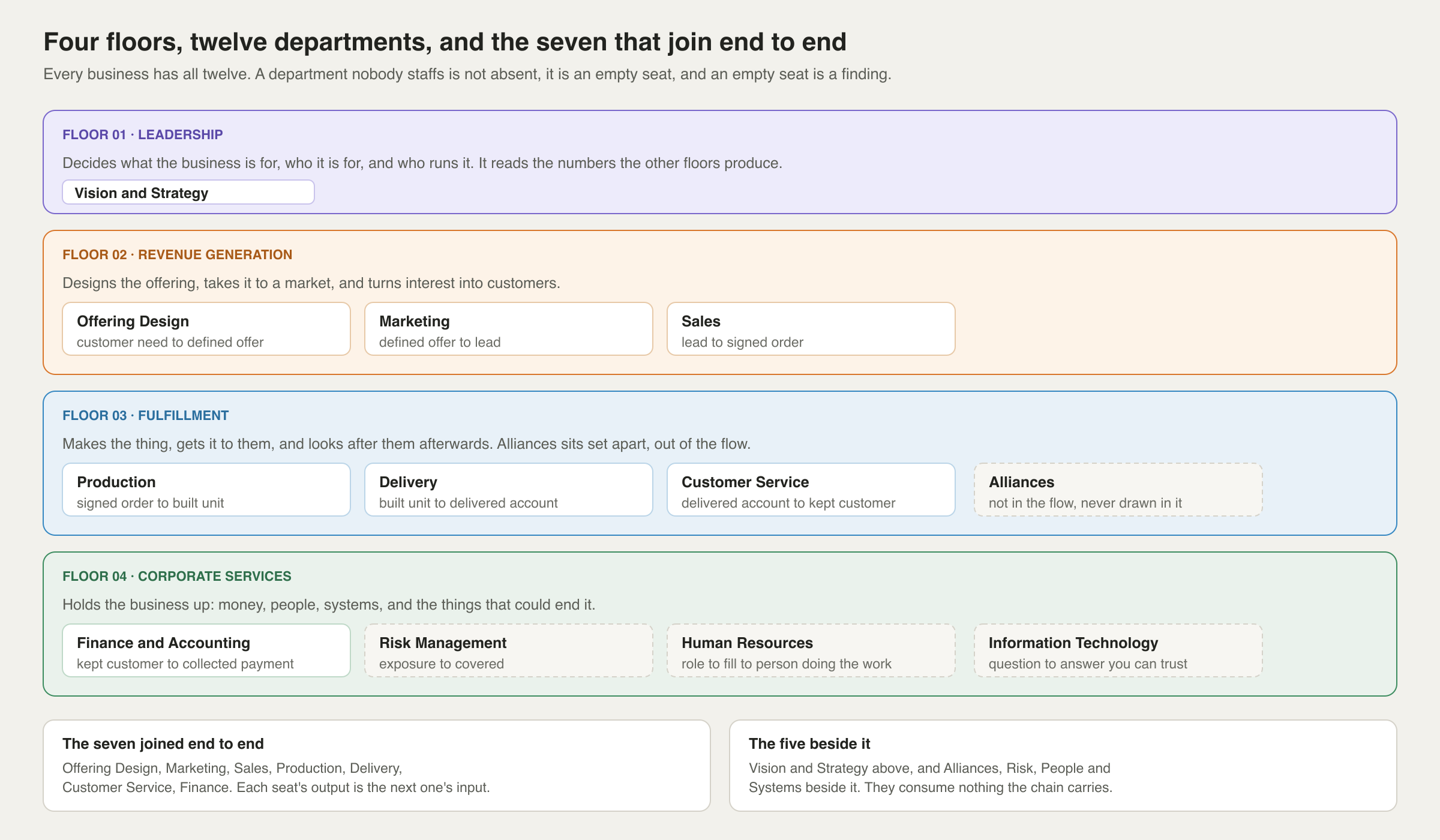
4. Twelve departments, and two rules that never bend
Twelve, always, on every canvas. Two rules go with them and they are the two most useful sentences in this module when you are sitting in front of an owner.
Rule one. Every business has all twelve. A department nobody staffs is not absent. It is an empty seat, and an empty seat is a finding. This is the entire reason the canvas draws departments the owner has not thought about. When a plumbing firm's canvas shows Human Resources with nobody in it, the canvas is not wrong and it is not being pedantic: it is saying that hiring is happening in somebody's head, on a Sunday, with no method and no record, which is exactly the thing that will break when the fourth van arrives.
Rule two. Specialization is override, never rewrite. A business type may change labels, unit names, who usually holds a seat, the order of the chain, and which recipes arrive switched on. It may not invent a thirteenth department, and it may not delete one it finds inconvenient. So a trades business calls Production Dispatch and on site and Delivery Invoice and aftercare, and both are still Production and Delivery underneath.
4.1 The seven that join end to end
Seven of the twelve are joined, and each one's output is the next one's input, word for word.
| # | Department | The question it answers | In | Out |
|---|---|---|---|---|
| 1 | Offering Design | What are we selling? | customer need | defined offer |
| 2 | Marketing | How do they hear about us? | defined offer | lead |
| 3 | Sales | How do they say yes? | lead | signed order |
| 4 | Production | How do we make it? | signed order | built unit |
| 5 | Delivery | How do we keep the promise? | built unit | delivered account |
| 6 | Customer Service | How do we keep them? | delivered account | kept customer |
| 7 | Finance and Accounting | Do we actually get the money? | kept customer | collected payment |
The final unit is a kept customer. Not a sale, not a delivery. A customer who is still there. That choice is the whole argument of the model in one word, and it is the first thing worth saying to an owner who thinks the run ends at the invoice.
4.2 The five beside it
| Department | What it returns | Why it is not in the chain |
|---|---|---|
| Vision and Strategy | A decision, from the numbers the floors produce | It reads the run. It does not stand in it |
| Risk Management | Exposure, covered | It consumes nothing the chain carries |
| Human Resources | A person doing the work, from a role to fill | The same |
| Information Technology | An answer you can trust, from a question | The same |
| Alliances | A standing agreement, from a relationship | It is the one department that must never be drawn as if it were in the flow. On the canvas it sits set apart |
4.3 Three things that look like departments and are not
Sourcing, market and position, and the core team. Each of them is real work, each of them carries methods, and none of them holds a seat. Sourcing folds into Production, market and position fold into Offering Design and Vision and Strategy, and the core team folds into Human Resources.
If you catch yourself about to draw one, the question to ask is rule one's question: what goes in, what comes out, and what is the number between them? For sourcing the answer is Production's own answer, which is how you know it is not a thirteenth department.
5. What you actually see: the Example business
Everything from here on is shown on the business type the product ships as its example, Trades and home services: plumbing, electrical, HVAC, landscaping, roofing, cleaning. It was chosen because work arrives the same way in all of them, a call or a form, a quote, a scheduled job, an invoice, a chase, and because it is the type the catalog covers most completely.
Nothing in this section is a mock-up. Every frame is the product as it stands.
5.1 The canvas starts with one question
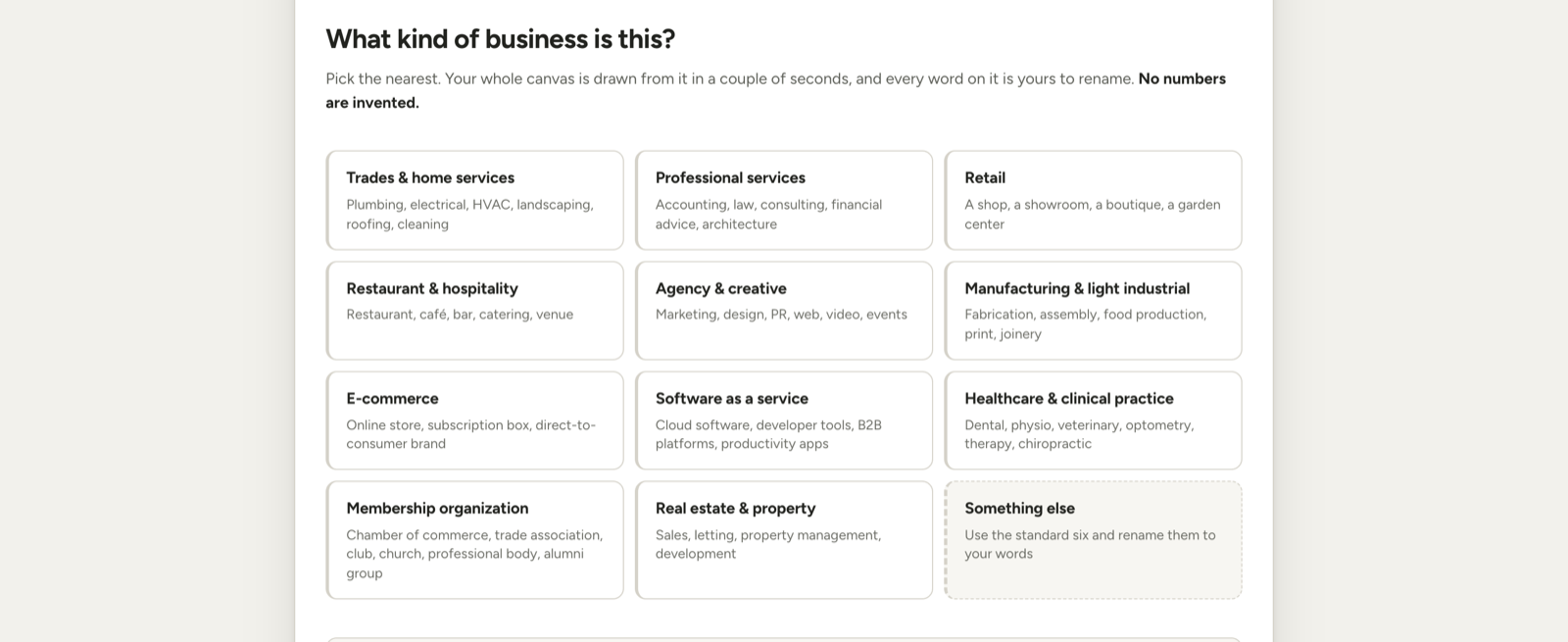
One question, twelve answers, and the sentence under the heading is the one to read aloud to an owner: "Pick the nearest. Your whole canvas is drawn from it in a couple of seconds, and every word on it is yours to rename. No numbers are invented."
Two things follow from that screen and both are rubric lines later.
- The type names the opening set. Picking Trades and home services is what places fifteen seats rather than some other fifteen. The rubric's first line fails a canvas whose business type is named and whose opening set is not the one that type names.
- No numbers are invented. The canvas arrives with no measurement of this business at all, because an invented number is worse than a blank one: a blank one gets filled in and an invented one gets believed.
5.2 The run, and the units on it
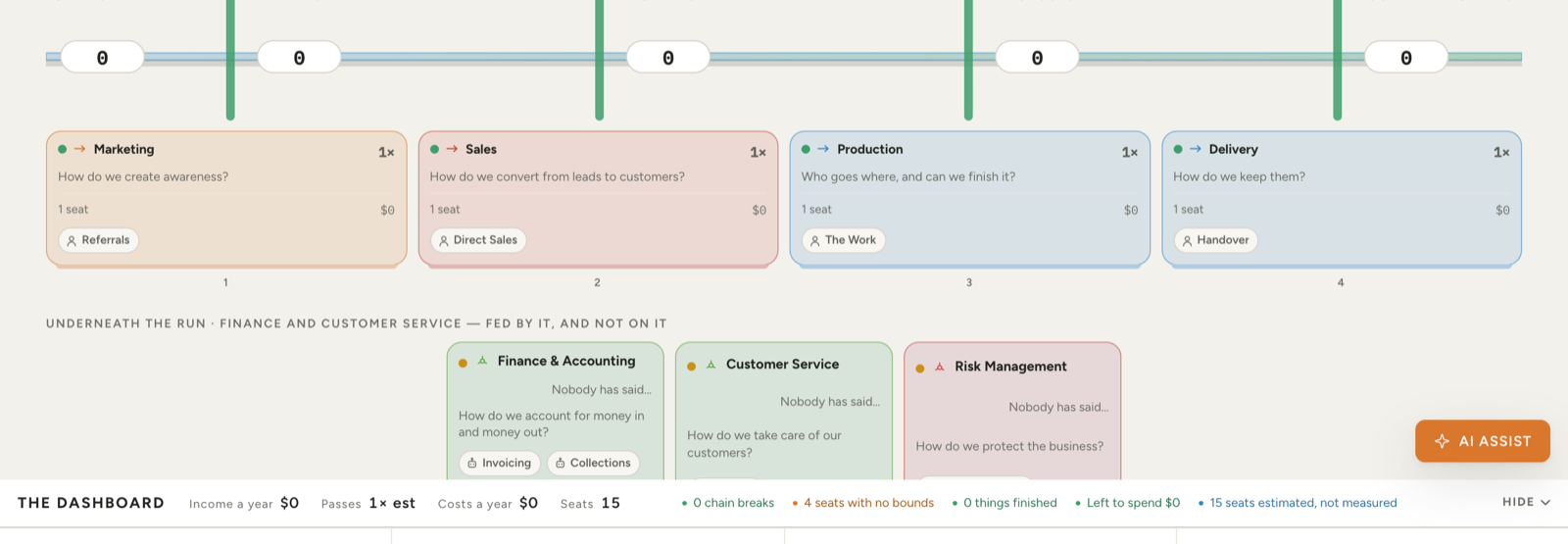
This is the run: how one offer becomes money. Read the words along the top, because those are the units, and units are the most load-bearing idea in this module.
| The counter reads | Between | Which is |
|---|---|---|
| OFFERS | into Marketing | what Offering Design handed on |
| LEADS | Marketing into Sales | what Marketing made out of an offer |
| ORDERS | Sales into Production | what Sales made out of a lead |
| PRODUCTS | Production into Delivery | what Production made out of an order |
| COMPLETED ORDERS | out of Delivery | the last thing the spine carries |
Underneath each counter is the department that produces it, with its question written on it: How do we create awareness?, How do we convert from leads to customers?, Who goes where, and can we finish it?, How do we keep them? Those questions are the department's own, they are the same twelve questions on every canvas, and a business type may reword them.
Notice what the counters all read on a canvas that has just been opened: 0. Not a guess, not an industry average. Zero, and the dashboard says so in its own words further down.
5.3 Where the money goes, and what comes back
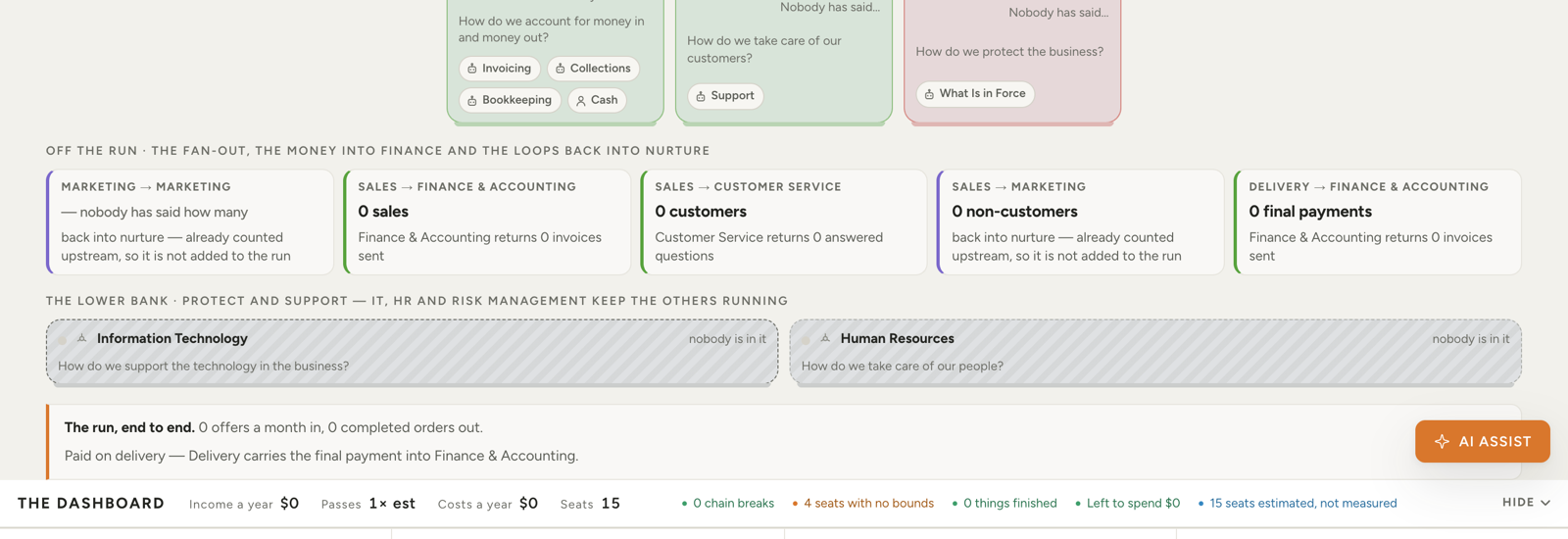
Three things in this frame are worth stopping on.
The fan-out. Sales does not produce one thing. It produces an order that goes to Production, a sale that goes to Finance, a customer that goes to Customer Service, and a non-customer that goes back to Marketing. Four outputs, four destinations. That is not a branch: a branch is one output going to two places, which is a different thing and needs a split. Two outputs going to two places is just a department doing its job.
The loops. Two of the arrows in that frame go back into nurture, and both are labeled already counted upstream, so it is not added to the run. A model that counted a returning lead twice would show a business converting more than one hundred percent of what arrived, which is the sort of number that ends a conversation with an owner.
The lower bank. Information Technology and Human Resources sit under everything, drawn in a hatched box that says nobody is in it. Read rule one again. That is not an omission in the drawing. It is the drawing telling you something true about this business.
5.4 Departments hold seats, and seats hold recipes
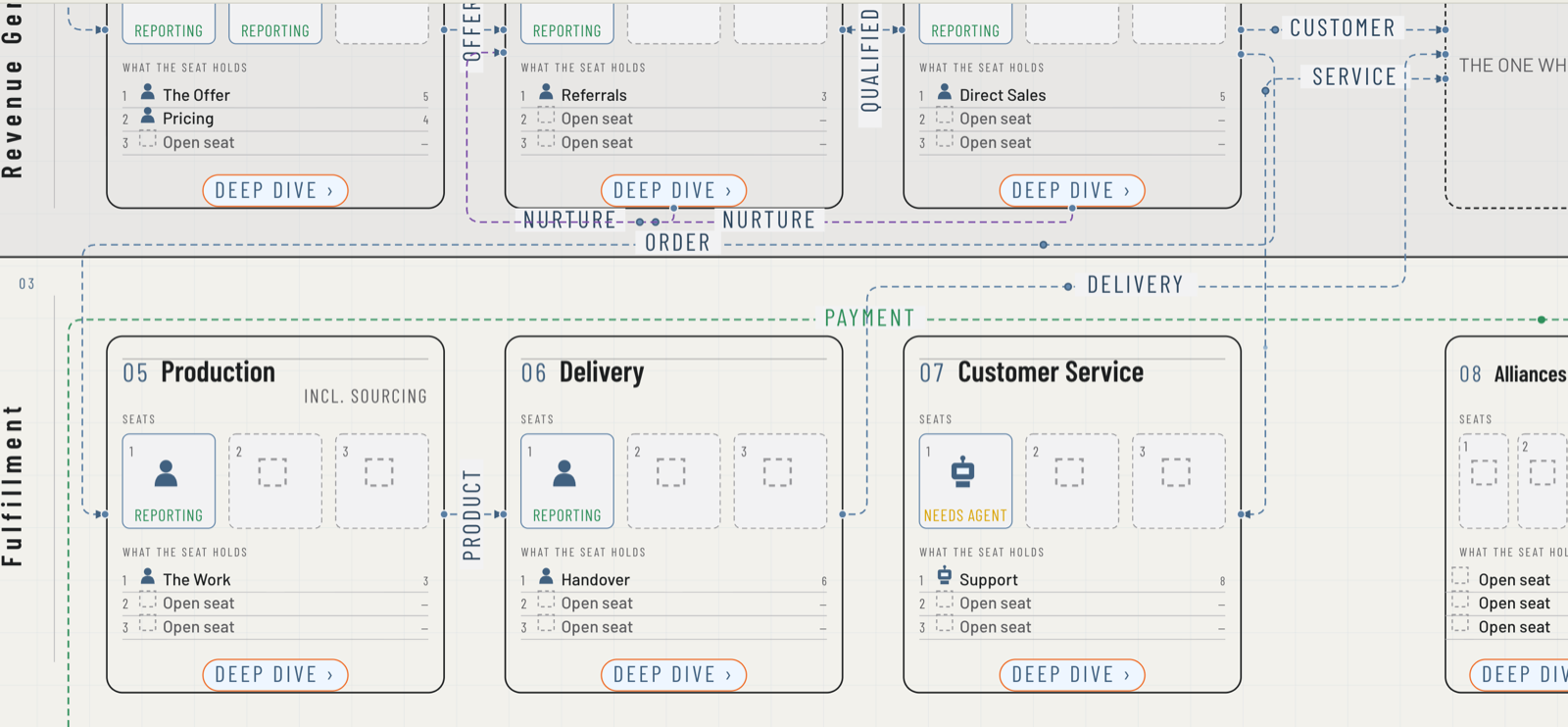
This is the same canvas one level down, and it is where the three nouns separate cleanly.
| It is | It carries | The test | |
|---|---|---|---|
| Department | Where work is measured. Twelve, always present, never added or removed | An input, an output, a ratio | It is one of the twelve. There is no thirteenth |
| Seat | Who holds it. A role a person, a firm or an agent holds under one agreement | A holder, a cadence, a gate, a cost, a measured ratio | Does something outside this card consume what it returns, or does somebody hold it on their own clock? |
| Recipe | What runs inside it. One piece of work with its own contract | Takes, does, returns, a bar, a gate, and its own ports | Is its whole output eaten by exactly one other card, and does nobody hold it? |
On the card for Offering Design you can read all three at once: the department, then a SEATS row with three slots, then WHAT THE SEAT HOLDS listing The Offer with 5 beside it and Pricing with 4. Five and four are counts of recipes inside those seats.
Look at the wires between the cards. Each one is labeled with a unit: OFFER, QUALIFIED, NURTURE, ORDER, PRODUCT, DELIVERY, PAYMENT, CUSTOMER, SERVICE. That word is not a description of the wire. It is the wire's type.
5.5 A port is one unit, one way, and the match is exact
A port is one thing going in or out, in its own unit, on one card. One per unit, each way. A seat that takes one unit has one in-port however many arrive; a seat that takes two different units has two.
Three rules go with it and the third is the one candidates trip on.
- A port is typed, and the unit is the type. Because there is one port per unit, naming the unit is enough to say where a wire lands.
- A port on a seat is derived, not authored. A seat takes what nothing inside it produces, and returns what nothing inside it consumes. Author the recipes and the seat's ports follow.
- Exact means exact. Two ports join only when their units are the same after trimming the spaces and lowering the case. Nothing else is a match.
ad imagedoes not matchad images, orimage, orcreative. There is no synonym list, no stemmer and no plural table, and that is deliberate: a wire that joined on a near match would join two things nobody checked.
A thing that does not drain is not a port. It is an ingredient. A mailbox, a ledger, a CRM: a recipe needs them and never uses them up, so they are not counted on the run. That distinction saves an hour of argument the first time somebody tries to wire a mailbox to a seat.
5.6 What earns a seat, asked one question at a time
You will be given a list of work an owner does and you will have to decide which pieces are seats and which are recipes inside somebody else's seat. Do it in this order, and stop at the first yes.
| # | Question | If yes |
|---|---|---|
| 1 | Does something outside this card consume what it returns? | Seat |
| 2 | Does the department itself return what this card returns, is it the chain unit? | Seat. Its output leaves the building |
| 3 | Does a person or a machine hold it, with its own cadence, its own gate and its own cost line? | Seat |
| 4 | Is its entire output consumed by exactly one other card? | Recipe, inside that card's seat |
| 5 | Is its output consumed by two or more cards, and nobody holds it? | Seat, and a shared one |
A holder is an agreement, even when the work is small. That is the sentence to remember from question 3. If one named person is answerable for something on their own clock, it is a seat, however little of it there is, because the structure follows the agreement rather than the arithmetic.
5.7 A seat's agreement
Every seat carries one, and four parts of it are what the rubric names: what it takes, what it returns, the bar, and the cadence. Takes and returns are derived from the recipes inside. The bar is how you would know this worked. The cadence is how often it runs, chosen from real periods: a day, a weekday, a week on a named day, a month on a date, a quarter, or a number of times a period.
There is no "continuously". It is not offered and it is not used, and the reason is worth carrying into a client conversation: a seat that runs continuously has no moment at which anybody looks at what it did.
Beside the cadence sits the gate: where the work must stop and ask a person. A seat held by an agent defaults to "Drafts only. Never sends." A seat held by a person defaults to no gate, because the person is the gate.
5.8 An empty seat is a finding, and the canvas says so out loud
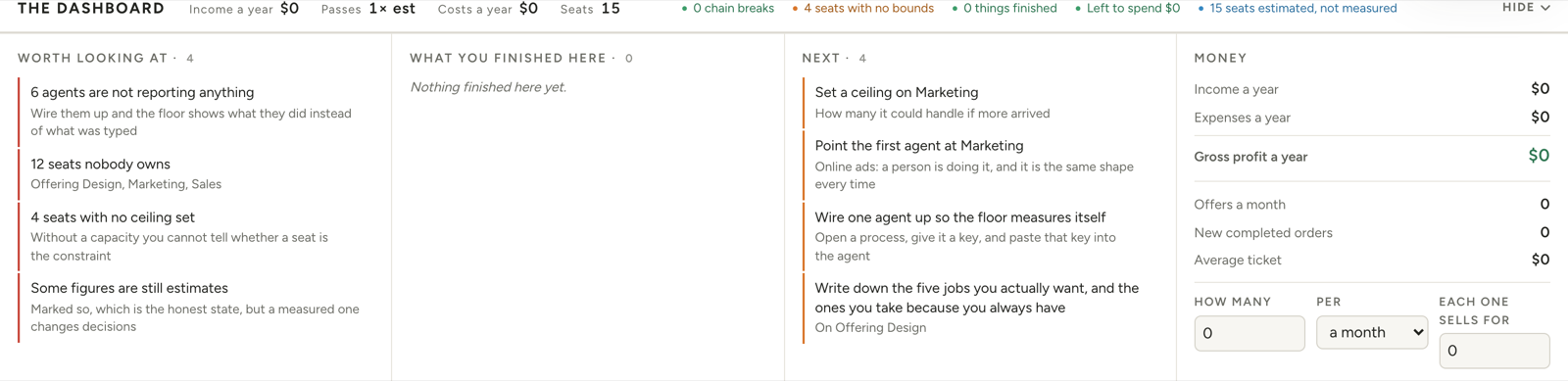
This is a canvas nobody has touched, and the product is already telling its owner four true things: six agents are not reporting anything, twelve seats nobody owns, four seats with no ceiling set, and some figures are still estimates and are marked as such.
Read the last one again. Marked so, which is the honest state, but a measured one changes decisions. That sentence is the model's whole attitude to numbers, and it is the one you will repeat most often in a diagnostic.
6. Four exercises, on your own canvas
Do these in order, on a canvas you open yourself. Each one says what you should end up with, so you can mark yourself. None of them needs anything but a browser.
Exercise 1 · Open a canvas and count what arrived
Do this. Open a new canvas. Choose Trades and home services. Skip the numbers when it offers to take them. When the orientation tour appears, skip it too.
Then answer, from the screen and not from memory:
- How many departments does the header say the canvas has?
- How many seats does it say were placed?
- Which departments arrived with nobody in them at all?
What you should have. Twelve departments, fifteen seats placed, and three departments carrying no seat: Alliances, Human Resources and Information Technology. If you got twelve and fifteen and found the three, you have read the screen correctly.
Why the exercise exists. The count is not trivia. A candidate who cannot say how many seats arrived cannot later say which ones they added, and the rubric marks exactly that difference.
Exercise 2 · Read the units off the run
Do this. Stay at business level and scroll down to the chain.
Then write down, in order, the five units the counters carry, and beside each one the department that produces it.
What you should have.
| Unit | Produced by |
|---|---|
| offers | Offering Design |
| leads | Marketing |
| orders | Sales |
| products | Production |
| completed orders | Delivery |
Then answer one more. What number does every counter show, and why?
What you should have. Zero, on every one, because the canvas arrives with no measurement of this business. If you wrote anything else, you read an example number as a measured one, which is the mistake section 7 lists first.
Exercise 3 · Seat or recipe
Here are six pieces of work a plumbing firm does. For each one, walk the five questions under What earns a seat in order, then write down the first one that answers yes, and the verdict.
- Answering the phone when a customer calls about a new job.
- Checking, once a week, that the public liability certificate has not expired.
- Writing the quote after a site visit.
- Chasing a quote nobody answered.
- Sending the invoice once the job is signed off.
- Deciding, each quarter, which two postcodes to stop serving.
What you should have. Something close to this. The verdicts matter more than the exact wording of the reason.
| # | First yes | Verdict | Why |
|---|---|---|---|
| 1 | Q1 | Seat | What it returns, a qualified enquiry, is consumed outside the card, by Sales |
| 2 | Q3 | Seat | Somebody is answerable for it on their own clock, monthly, in Risk Management, and it has a gate |
| 3 | Q4 | Recipe | Its whole output is consumed by one card, the seat that closes the sale |
| 4 | Q4 | Recipe | The same. It feeds the same seat and nobody holds it separately |
| 5 | Q2 | Seat | Its output is the department's own chain unit and it leaves the building |
| 6 | Q3 | Seat | A named person, a real cadence, and a decision nobody else may take |
If you marked 3 and 4 as seats, you sized the work rather than asking the questions. Both are real work and both take real judgment, and neither is held by somebody separately on their own clock.
Exercise 4 · Name three absences without filling any of them
Do this. On the same canvas, find three places where the canvas is telling you something is missing. Write one sentence for each, in this shape: what is empty, what that means about the business, and the question you would ask the owner about it.
What you should have. Three sentences that name the absence and end in a question. For example: Human Resources has no seat. This business hires without a method and without a record. Who decided the last person you took on, and what did you use to decide it?
What you must not have. A sentence that says what the business probably does. They probably use an agency for hiring is an invented fact, and on the exam it fails the rubric line that forbids stating anything the brief did not say as though the brief said it. Name the absence. Ask the question. Write nothing in the gap.
7. The common mistakes
Six, in the order candidates make them.
| # | The mistake | Why it happens | What to do instead |
|---|---|---|---|
| 1 | Reading an example number as a measured one | A canvas that shows a figure looks like it knows something | Check whether the figure is marked as an estimate. The canvas says so, on the dashboard, in words |
| 2 | Inventing a thirteenth department | The owner has a word for something that does not match any of the twelve, usually sourcing or partnerships | Ask what goes in, what comes out and what the number between them is. It will fold into one of the twelve. Alliances exists for the partner register and is still out of the flow |
| 3 | Deciding seat or recipe by how big the work feels | Big work feels like it deserves a card | Walk the five questions in order. Question 3 is the one that settles most of them: is one named person answerable for it on their own clock |
| 4 | Drawing Alliances in the flow | It has arrows going to it in the owner's head | Alliances consumes nothing the chain carries. It sits set apart, always |
| 5 | Joining two ports whose units nearly match | job and jobs obviously mean the same thing | They do not join, and the refusal is on purpose. Rename one of them so that they actually agree, and write down that you renamed it |
| 6 | Filling an empty seat with a guess about the business | An empty box looks like an unfinished drawing | An empty seat is a finding. Name it, ask about it, and leave it empty until somebody answers |
Mistakes 1 and 6 are the same mistake pointed in two directions, and between them they are the most common reason a candidate fails the exam: both are the habit of closing a gap rather than reporting it. The whole of this program's standard rests on the opposite habit.
8. Knowledge check
Twelve questions. Answer them from memory before you look anything up. The answers and the reasoning for each one are in this module's answer key, which is a separate document your facilitator holds.
- Name the four floors, in order.
- Which floor does Sales sit on, and what does that floor decide?
- How many departments does every canvas have, and may a business type add one?
- Which seven departments join end to end? Name them in order.
- Which department is on the Fulfillment floor and must never be drawn in the flow, and why?
- What is a unit? Give the unit that Marketing hands to Sales.
- What is the final unit the chain produces, and why is it that rather than the payment?
- Two seats carry ports whose units read
completed jobandcompleted jobs. Do they join? What do you do about it? - A card's entire output is consumed by exactly one other card, and nobody holds it. Seat or recipe?
- A named person spends twenty minutes a month checking that a certificate has not expired, and nothing else consumes what they produce. Seat or recipe, and which question settled it?
- A trades canvas opens with Information Technology carrying no seat. Is that a defect in the canvas, and what do you do about it?
- What does the model arrive with by way of measurement of the business in front of you, and what is the argument for that?
9. The practical task
Read a canvas back to somebody who has never seen one, in writing, in one page.
Do this. Open a fresh canvas for Trades and home services. Write a one-page read-back with four parts, in this order:
- What this business does, in the model's own words: the seven joined departments, each with the unit it hands on.
- What arrived: how many departments, how many seats, and which departments came with nobody in them.
- Three absences, each named, each with the question you would ask the owner, and none of them filled in.
- Every number you state, with a word beside it saying whether it is measured, an estimate, or absent.
Pass criteria, tied to the lines you will be marked on
These are the actual rubric lines, named. This task is not marked for certification, and it is the smallest version of what is.
| This task | The rubric line it rehearses |
|---|---|
| The business type is named, and your read-back describes the opening set that type actually placed | Implementer line 1: the business type is named, and the opening set placed is the one that type names |
| Every one of the twelve departments appears in your read-back, and any that carries no seat is written down as carrying none | Implementer line 2: every department the business actually runs carries at least one seat, or the canvas says in writing why it does not |
| Nothing in your read-back states a fact about the business that the screen did not give you | Implementer line 15: nothing the brief did not say is stated as though the brief said it; every gap is named as a gap |
| Your read-back is readable by somebody who was not sitting with you | Implementer line 17 (flexible): the canvas can be read by somebody who was not in the diagnostic |
| You used the model's words, floor, department, seat, port, unit, rather than your own | Implementer line 19 (flexible): the read-back uses the model's vocabulary rather than the candidate's own |
How to mark yourself. Lines 1, 2 and 15 are mandatory on the exam, so treat them as pass or fail here: one invented fact anywhere in the page is a fail of line 15, however good the rest is. Lines 17 and 19 are flexible, so note them and move on.
10. A facilitator's note: running this live in 90 minutes
The self-paced shape is 3 hours. Live, it is 90 minutes, and the difference is that the reading becomes a conversation and two of the four exercises are dropped.
| Minutes | What happens | What you are watching for |
|---|---|---|
| 0 to 10 | Open cold. Before showing anything, ask each person to name the departments of a business they know. Write the list up | Almost nobody says twelve, and almost nobody says Risk Management. That gap is the module |
| 10 to 25 | The four floors and the twelve departments, from section 3 and section 4, against the list you just wrote | Somebody will offer a thirteenth. Do not refuse it. Ask rule one's question, and let the group fold it in |
| 25 to 45 | Open a canvas live, Trades and home services, and walk sections 5.1 to 5.3 on the screen | Watch for anybody writing down the zeros as if they were results. Say out loud that they are zeros |
| 45 to 60 | Exercise 3, seat or recipe, in pairs, six items, five minutes to do and ten to argue | The argument about item 3, the quote, is the module's most valuable ten minutes. Let it run |
| 60 to 75 | Exercise 4, name three absences, alone, then read two aloud | Cut off anybody who fills a gap. Kindly, immediately, every time. This is the habit the program is built on |
| 75 to 85 | The six common mistakes, section 7, read against what the group actually did in the last half hour | Name mistakes the group made. It is a better lesson than a list |
| 85 to 90 | Set the knowledge check and the practical task as homework | Say that the practical task's line 15 is marked as pass or fail |
Three things to prepare. A canvas already opened on a second screen in case the network is slow. The answer key, which you hold and the group does not. And your own honest answer to the question somebody always asks in the first ten minutes: what happens when the owner's business genuinely does not do one of the twelve. The answer is rule one, and it is worth saying in your own words before you need it.
One thing not to do. Do not open the seat card or a recipe. It is module 2 and module 3, the group will want to go there, and a facilitator who follows them loses the second half of this module and teaches neither well.
Changelog
| Version | Date | Change |
|---|---|---|
| 1.0 | 2026-09-19 | Written, on the day Craig started the build. The first module of the Implementer curriculum: the six things a learner can do at the end, the three-level definition, the four floors, the twelve departments with the two rules, the seven joined end to end and the five beside them, the three areas that are not departments, units and ports with the exact-match rule, the five questions that decide seat or recipe, the seat's agreement, and an empty seat read as a finding. Four exercises with their expected results, six common mistakes, a twelve-question knowledge check whose answers are held in a separate document, a practical task with its pass criteria tied to named rubric lines, and a facilitator's note for 90 minutes. Seven figures: one authored, and six frames of the product as it stands on the shipped Trades and home services example |